

Five HMOs. Four probiotics. One daily synbiotic.
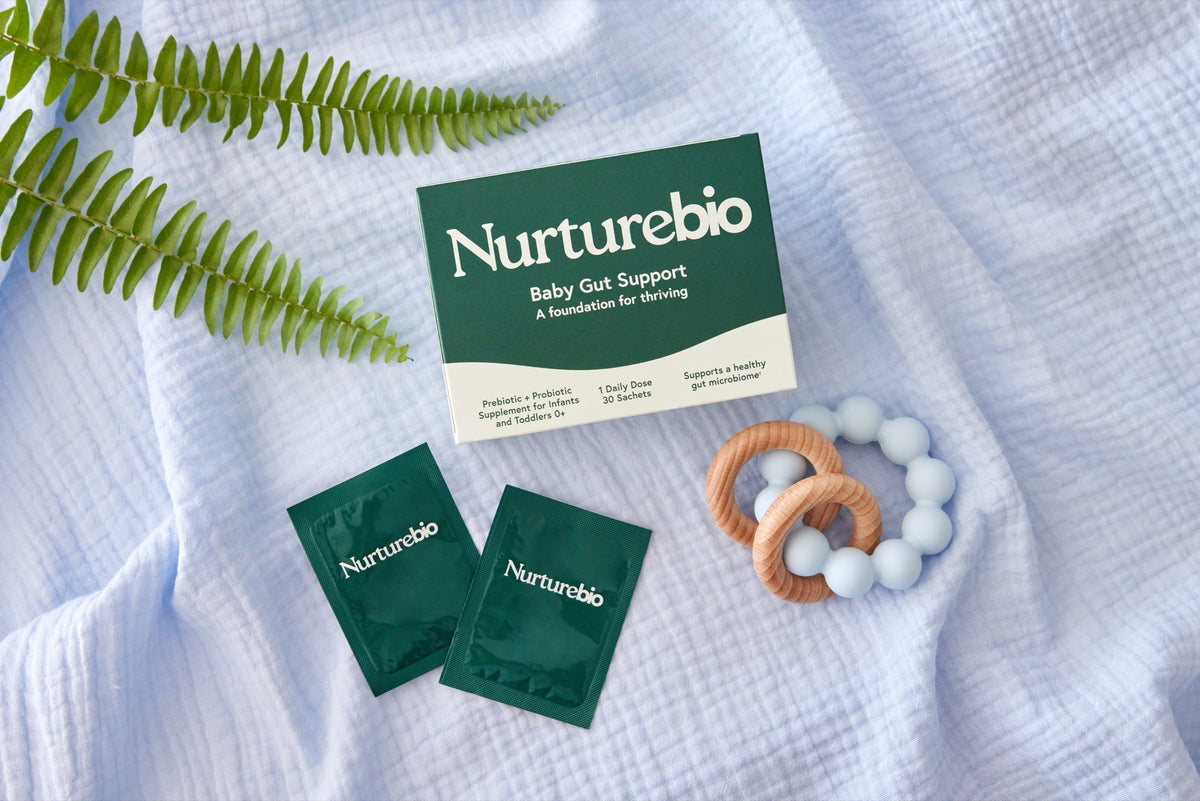
NurtureBio pairs 400 mg of five human milk oligosaccharides with 3 billion CFU of infant-friendly probiotics, including B. infantis, B. bifidum and L. reuteri. Made for babies and toddlers from birth through 48 months.
- Works with breast milk, formula or combination feeding
- One premeasured sachet per day
- Third-party tested and Clean Label Project certified
HMOs are one side of the microbiome equation.
HMOs nourish beneficial bacteria. NurtureBio pairs five structurally distinct HMOs with four probiotic strains selected for early-life gut health, providing both sides of a daily synbiotic in one sachet. Five structurally distinct HMOs paired with four infant-friendly probiotics.
Probiotics introduce beneficial bacteria
Four live strains selected for the infant gut, including B. infantis, B. bifidum and L. reuteri.
HMOs feed those bacteria
Five HMOs act as the prebiotic fuel these bacteria are biologically suited to consume.
Together they support a balanced infant gut
Bacteria plus their food in one sachet — the two sides of a daily synbiotic working together.
Five structurally distinct HMOs paired with four infant-friendly probiotics.
Designed for every feeding journey
Optional daily support alongside breast milk
Breast milk naturally contains a diverse mixture of HMOs. NurtureBio provides a standardized five-HMO blend paired with four probiotics as optional daily microbiome support.
Mixes into your baby’s regular formula
Many formulas already contain one or more HMOs. NurtureBio combines its five-HMO blend with four live probiotic strains and can be mixed with your baby’s regular formula.
Fits your existing routine
NurtureBio fits alongside combination feeding without requiring a change to the family’s existing routine.
How HMOs feed the bacteria that build the infant gut
Babies digest very little of most HMOs. Much of their value comes from nourishing specific bacteria in the developing gut. In particular, HMOs support the bifidobacteria that dominate the gut of a healthy breastfed infant, with Bifidobacterium infantis being the most studied example.
This is what a synbiotic does that a probiotic alone cannot. A probiotic introduces beneficial bacteria. A prebiotic feeds them. A synbiotic delivers both at once.
Five distinct HMOs spanning three major categories
The blend spans the three major HMO categories found in breast milk: fucosylated, neutral non-fucosylated and sialylated.
2’-FL · Fucosylated2’-Fucosyllactose
The most abundant HMO in breast milk for most mothers. 2’-FL has been studied extensively for its role in supporting beneficial gut bacteria and the developing immune system. It is also the HMO most commonly added to modern infant formulas.
DFL · FucosylatedDifucosyllactose
A fucosylated HMO that pairs with 2’-FL in breast milk and supports a similar set of gut functions. Including DFL alongside 2’-FL gives the gut microbiome a closer match to the structural profile of breast milk than a single-HMO product can offer.
LNT · NeutralLacto-N-tetraose
One of the core neutral non-fucosylated HMOs in breast milk and a foundational substrate for Bifidobacterium infantis, the bifidobacterium most closely associated with the infant gut. LNT is part of how breast milk shapes which bacteria flourish in the early microbiome.
3’-SL · Sialylated3’-Sialyllactose
A sialylated HMO involved in gut development and studied in the context of brain development and cognitive function during early life. Sialylated HMOs make up a meaningful portion of total HMO content in breast milk.
6’-SL · Sialylated6’-Sialyllactose
The other major sialylated HMO in breast milk. 6’-SL helps nourish beneficial bacteria in the infant gut and has been studied for its role in early neurodevelopment alongside 3’-SL.
Looking for the full supplement facts? See our full formulation page
Built by parents, formulated with researchers
Built by parents who lived this
After our child developed five ear infections in five months, they were prescribed a different course of antibiotics each month. The infections cleared, but afterward our child struggled with chronic constipation.
We tried everything we could find: single-strain probiotics, personalized probiotics, fiber gummies, and laxatives. Nothing provided lasting relief. Then we learned about human milk oligosaccharides, the prebiotics that nourish beneficial bacteria in the infant gut, and began pairing HMOs with our child’s probiotics. That was when our child finally found relief.
The experience showed us what had been missing: a product that combined infant-focused probiotics with the HMOs designed to nourish them. So we built the product we wished had existed for our family.
Grounded in human milk science
NurtureBio was formulated with a scientific advisory board of researchers among the most cited in human milk and infant microbiome science, and is supported by active clinical research at the University of Cincinnati College of Medicine.
Where the HMOs come from
Not extracted from human breast milk
NurtureBio’s HMOs are produced through precision fermentation and are not extracted from human breast milk.
Milk is listed as an allergen because the process begins with milk-derived lactose. The finished HMOs do not contain milk protein.
One premeasured sachet a day
Give one premeasured sachet per day, mixed into a small amount of breast milk, formula, water, or soft food. For younger babies on milk only, mixing into a small volume of breast milk or formula tends to work best.
NurtureBio is a daily nutritional supplement, not a treatment for any medical condition. Your pediatrician is the right place to start with questions about your baby’s nutrition.
Formulated with leading researchers in human milk and infant microbiome science
Active clinical research · University of Cincinnati College of Medicine
Common questions from parents
What are HMOs?
Human milk oligosaccharides, or HMOs, are special carbohydrates that make up the third most abundant solid in breast milk after fat and lactose. Babies digest very little of most HMOs. Much of their value comes from nourishing specific bacteria in the developing gut.
Why does NurtureBio contain five HMOs?
NurtureBio includes five distinct HMOs spanning the three major HMO categories: fucosylated, neutral non-fucosylated and sialylated. The five are 2’-fucosyllactose, difucosyllactose, lacto-N-tetraose, 3’-sialyllactose and 6’-sialyllactose — a closer match to the structural diversity of breast milk than a single-HMO product.
Why pair HMOs with probiotics?
HMOs nourish beneficial bacteria. Pairing them with four live probiotic strains provides both sides of a synbiotic in one sachet: the bacteria and the food they eat. A probiotic alone introduces bacteria; a synbiotic also feeds them.
Can I use it if my formula already contains HMOs?
Yes. Many formulas already contain one or more HMOs. NurtureBio combines its five-HMO blend with four live probiotic strains and can be mixed with your baby’s regular formula.
Can I give it to a breastfed baby?
Yes. Breast milk naturally contains a diverse mixture of HMOs. NurtureBio provides a standardized five-HMO blend paired with four probiotics as optional daily microbiome support.
Where do the HMOs come from?
NurtureBio’s HMOs are produced through precision fermentation and are not extracted from human breast milk.
Why is milk listed as an allergen?
Milk is listed as an allergen because the precision fermentation process begins with milk-derived lactose. The finished HMOs do not contain milk protein.
How do I give it to my baby?
One premeasured sachet per day, mixed into a small amount of breast milk, formula, water, or soft food. For younger babies on milk only, mixing into a small volume of breast milk or formula tends to work best.
What ages is it for?
NurtureBio is made for babies and toddlers from birth through 48 months.
Five HMOs. Four probiotics. One daily synbiotic.
Start with 50% off your first subscription order. Skip or cancel anytime.